




Equipping the saints for the work of the ministry certainly includes the skills needed to run church programs, but is that all? Matt Rusten begins his 208-page book, Pastoring for Monday: Help Your Congregation Integrate Faith and Work (IVP, 2026), by recalling the vocational blind spot of his home church and how his father’s work as a dedicated high school superintendent went unnoticed.
His father was not taught to think biblically about his vocation in which he touched the lives of the faculty, students, and parents. Sadly, he neither sought nor expected support from his church. The equipping for ministry he received on Sunday had little or no connection with what he did from Monday to Friday.
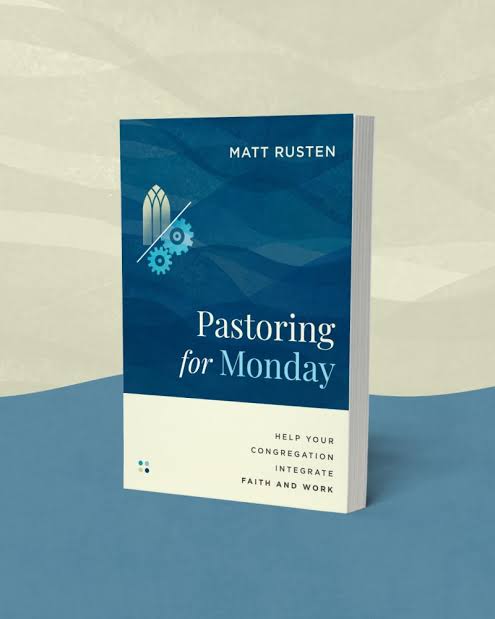
Pastoring for Monday: Help Your Congregation Integrate Faith and Work
Matt Rusten
Purchase on Amazon.caPurchase on Amazon.comPastoring for Monday: Help Your Congregation Integrate Faith and Work
Matt Rusten
Discipleship That Includes Work
The question Matt Rusten wants pastors to ask themselves is a powerful one:
That a proper understanding of work should be among the first principles of discipleship is implied in several conversion accounts in the Gospels, not to mention the specific commands of the Apostles. The soldiers and tax collectors who accepted John the Baptist’s call to repentance asked what they should do. “Do not extort money from anyone by threats or by false accusation, and be content with your wages,” they were told (Luke 3:13–14).
In other words, return to your jobs on Monday morning with a new attitude and purpose. There you will find people to serve and it will be at work where spiritual formation occurs and your progress as a disciple is measured. Rusten quotes Tish Harrison Warren, who wrote, “The crucible of our formation is in the anonymous monotony of our daily routines” (74). While the preaching of the gospel is essential, when it is beautifully adorned by transformed lives in the workplace, it is an unstoppable force.
If discipleship means we are to follow Jesus’s example, it must include a service paradigm. Rusten argues that our workplace is the arena in which we serve wearing work gloves, not boxing gloves. Nothing is excluded; the way we answer emails, prepare for meetings, and pay vendors is a form of humble service where we value others as Christ calls us to (Phil. 2:3–4).
Connecting With Congregants in Their Work
Our work, while toilsome in the present age, will be rewarded with great, fulfilling, and significant work in our glorious future (65). The administrator whose work is laborious in the fallen world looks forward to the day when it will be consummated. This insight helps make sense of passages like Revelation 2:26, where faithful labourers are encouraged by the promise of working with Jesus in the administration of the nations.
Preachers who want to “pastor for Monday” can learn from the strategy of Jesus, who in his teaching of parables did not hesitate to identify his hearers with their work of farming, shepherding, fishing, or building. Jesus himself spent most of his life as a carpenter (tekton), and as such was very familiar with the working world.
Pastors whose seminary careers have limited their work experience would do well to visit congregants at their workplace and take an interest in their vocations. Haddon Robinson would write out the names and professions of several church members and keep them visible as he prepared his sermons. He wanted to pastor them for real life.
Some preachers review their sermons with a small group so as not to miss key applications (110). Rusten suggests that small vocation-based groups can encourage and mentor disciples and serve as mission platforms. Although the prospect of yet another church program might sound burdensome, it could bear fruit if carefully introduced.
Vocational Re-enchantment
Peter taught us to see ourselves as priests (1 Pet. 2:9). Rusten wonders enthusiastically what it would be like if employers and employees sought ways to represent God’s character at work and to intercede for their team, customers, organization, and industry (137). This single paradigm shift alone could “re-enchant” a worker’s experience of their otherwise dreary labour.
As Rusten explores in chapter 10, re-enchantment is the final stage of a worker whose initial enchantment for one’s work has soured along the same lines endured by Qoheleth in Ecclesiastes. Re-enchantment occurs when a person sees his work as a ministry, the fruit of which will echo throughout eternity (172). It requires “exegetical effort” to see the process from enchantment to disenchantment to re-enchantment as clearly as Rusten does, but it does shed light into the nature of work.
Navigating Transitions
Pastoring for Monday includes caring for church members when they are in career transitions. Whether planned or a crisis, such transitions can highlight areas of growth and care that should not be overlooked by church shepherds who want to know their sheep.
The transition to retirement is especially noteworthy to this recently retired reviewer. Rusten cites the retirement plan for the Levites over 50 (154). While retired from the heavy lifting of the priesthood, they were encouraged to assist their brothers (Num. 8:24–26). Retired people have crystallized wisdom to share with their brothers and sisters which is good for the church, but it also maintains their sense of purpose in God’s great plan.
Rusten concludes with a practical real-life case study of a pastoral team that reimagined what their church would be like if they adjusted their discipleship strategy to equip people for a majority of their lives (176).
Rusten’s work is a particularly helpful resource for pastors who want to help their congregants see the spiritual value of their day-to-day work.